Showing posts with label tutoring. Show all posts

Thursday, March 3, 2016

Shut up and Think with Me


You waltz into a session and a student has an essay. You read it out loud, fix a couple of grammar mistakes, and you’re good. Until you and the tutee stumble on a paragraph that needs to be changed or rewritten. You start asking a couple of open ended questions and the tutee is inspired. He picks up his pen and begins writing with zeal, until you start yapping with your big ol’ mouth.

Your intent is good; you’re just trying to give the tutee some ideas. But from the perspective of a tutee, please shut up. The tutee has a train of thought and is getting somewhere, until he gets distracted by your words.


I promise you, at appropriate times, silence isn’t awkward. You may feel the need to fill the quietness; just let it be. And you know, silence is golden, but duct tape is silver :)


I’ve experienced this a couple of times with tutoring creative writing. I was having my creative writing piece tutored and I decided I wanted to add a couple of new lines to my poem. My tutor asked some great open-ended questions and I got where I was going.  But my tutor saw that I was quiet and asked some more questions; she didn’t realize that I was thinking and that her questions were distracting me. I needed some quiet time to develop my ideas.


In a tutoring session where a tutee is coming up with ideas, try to give the tutee some space. And hey, if you can’t keep the silence, leave: I am serious. Let us say the tutee needs to rewrite a paragraph, tell the tutee you’re going to get some water or you’re going to the bathroom (lying is okay for the sake of education). Or maybe you can stay by the tutee and do your own thing so that you’re at the tutee’s disposal.

You might call this lazy, but I’m going to be generous and call it a minimalist tutoring ideology.
I think tutors are available to guide tutees in the right direction and  as soon as you guide them, let ‘em go. Our purpose as tutors is to create better writers; you are giving tutees a chance to practice their skills when you give them some space.


Some tutors, who teach by the book, feel that they are not doing their job if they’re not constantly asking questions. Open ended questions are good to get ideas going, but as soon as an idea develops, you can stop. You also have to remember that tutees can’t answer your questions on demand. They need time to think and then when they are ready, they’ll answer. Bombarding them with questions isn’t going to help them answer the first question you asked; it’s just distracting.


I’ve found that this method works for me and my tutees, but of course, like any strategy, tutors may like it or hate it. You just have to find what is most beneficial to you and the students you are helping.


Do you agree with the method? What strategies do you use? Let me know in the comments below or email me!

Oh and here’s a cool blog from Saint Mary’s University that also talks about how silence can be used as a tool.

Tutor Take the Wheel!

By: Candice Wong


Your hands tremble in your lap, your lips slowly dry out as each minute passes, and your heart hammers against your chest as you await your unpredictable fate ahead; these are the shared signs of anxiety before your first driving lesson and your first tutoring session.

Okay, I guess that was a bit dramatic, but you can’t disagree that ‘firsts’ give you the bad case of the butterflies in your stomach. Despite the fact that you grew up observing the road as a passenger or experienced being the tutee for many years, suddenly sitting in the driver’s seat literally and figuratively as a tutor can leave your mind swirling in confusion. In both cases, you don’t know what to expect. Not all roads are straight-shot; to get through a tutoring session and a driving lesson, you have to take many turns and maybe even a detour to get to your destination.


Every driver and tutor must be equipped with basic skills needed to perform their perspective tasks. The driver first learns how to control the gas pedal and the break of a car before they head out onto the road alongside other drivers. Similarly, the tutor’s ‘gas pedal and break’ practice is the simple training they receive before their first official tutoring session. Usually, they practice by observing other tutors. However, practicing driving in a parking lot and tutoring in a room amongst other experienced tutors is less intimidating. The only way to truly learn tutoring and driving is through experience with real-life situations that give you the ability to practice quick and critical thinking.

Even if you seemingly do everything right—signaling before turning, breaking slowly, and stopping at every stop sign—the possibility of a crash is inevitable due to the mistake of other people. The same goes for a tutoring session. There were times where I believed I perfected all the steps to make a tutoring session go smoothly as a tutor in my high school's writing center. I greeted the tutee, filled out the information sheet about what the tutee would prefer to focus on, and I even took the time to prepare handouts that the tutee might need. However, the tutee’s negative attitude stemmed from a stressful day at school made me crash to a point of confusion. The only solution was to focus on the aspects within my control—how I was going to remain positive and productive in the session and fulfill my role as a teacher. I continued being enthusiastic and engaged in my session even though the tutee did not put forth such an effort, yet I accepted that it was out of my control. I understood where the student was coming from since I’ve experienced some crummy days too.


You cannot learn driving or tutoring by solely watching someone else. Both require practice that gradually increases your skill level. There will always be bumps in the road that you don’t expect (and students who forget their rubric, assignment sheet, and basic grammar rules) but you learn through what these road bumps teach. The perseverance through these road blocks is what makes a good tutor and driver and don’t worry; I’ve done my fair share of crashing into a street sign as well.


Questions? Comments? Personal stories you’d like to share? I’d love to hear all of them! You can contact me by email here.

Let's Smell Rainbows Together

      Two summers ago it was time for me to say goodbye to my wisdom teeth. (AKA - have my wisdom teeth removed)
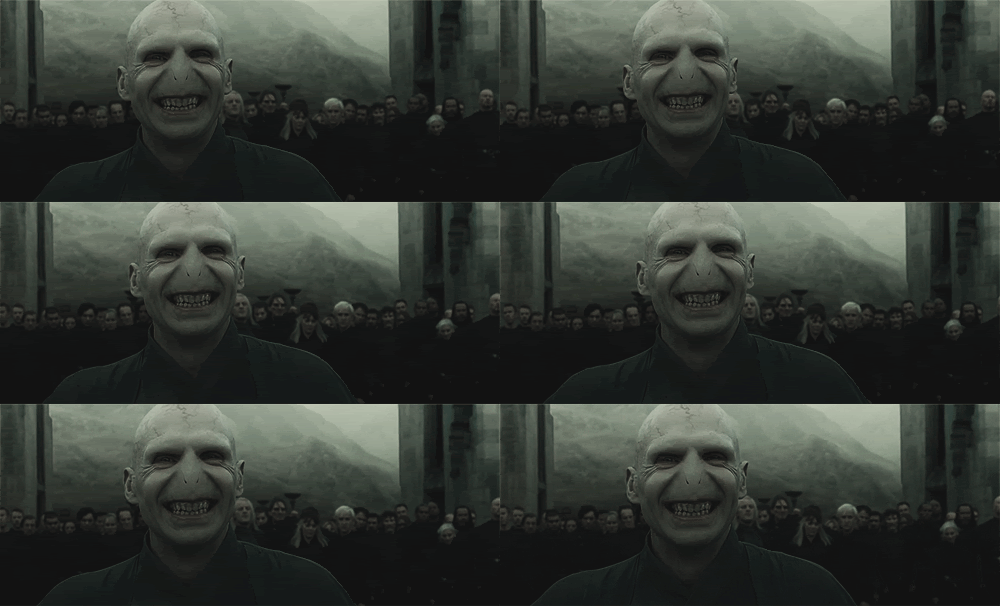
     The thing is when I told my friends we came up with a joke that when I was under the influence of the laughing gas I'd finally end up being able to smell - specifically rainbows. This would contrast my usual lacking of the sense of smell. I might as well have no nose, like Voldemort, since the ol' sniffer is useless to me.
The idea of having a working nose and smelling rainbows danced around in my head for weeks. Then the day came.
I was so nervous as I walked into the office with my two friends. We giggled and they both reminded me to tell them how rainbows smelled. My hands shook with a excitement as I sat down in the chair. "Rainbows!" I thought, "I"m going to smell freakin' Rainbows!!"
Suddenly, everything went black.
When I woke up later in the office I felt normal - except for the gauze filling in the holes where my
teeth once were. Even my friends thought I was acting normal on the gas. If anything I was just happier and gave more compliments.
That's when my friends made the mistake of asking me, "Autumn, do you smell the rainbows?!''
"NO!!!" I screamed as the tears came. I cried and cried gagging back the pain and frustration that my inability to smell will persist no matter what.
Similarly, Tutees at the Writing Center struggle. They get frustrated on writing papers and unsure about the structure, the grammar, the topic, citing, and countless other minuscule details that come along with writing. However, unlike me with my smelling, they can be helped. They can achieve a better ability in writing with their helpful buddy a... TUTOR FROM THE WRITING CENTER!!!
Unlike my friends, tutors don't mock tutees on their inability to do something. Tutors who work at the  Writing Center are there to help ease the frustration and comfort a tutee when under the pressure to preform well.
In this sense, writing for a tutee is like smelling for me - both of us go through moments of frustration and weakness lacking the ability to preform well in these fields. The Writing Center is here not only to help with papers, but also to increase personal confidence.
I guess the Writing Center is here to help people smell the rainbows.
LET'S SMELL RAINBOWS TOGETHER!!!!
Also, If you have any further questions email me!

Reverse-Tutoring?

What being a tutor in the WSWC taught me
By Hyunha Hwang

You want to teach both a cat and a dog how to sit. The dog immediately learns how to sit after you reward him with a bone. Assuming that all animals are the same, you do the same with the cat and reward her with a bone after each time she sits.

Obviously the cat did not learn how to sit, moreover annoyed at you.

Tutoring at the West Springfield Writing Center has taught me a similar lesson—or a realization—that not every tutee has the same process or incentive in achieving what they would like to achieve during their writing process. For example, there are tutees that come in to simply obtain the yellow pass required for a grade, and there are tutees who willingly walk in with the purpose of wanting to improve their writing. From that realization alone, being a tutor has given me the skill of asking various types of open-ended questions and suggesting ideas or corrections without having the tutee lose control of their paper.

“Different types” of tutees?

One tutee may come in with a partially complete paper and an “I-don’t-want-to-do-this” face, plopping down onto the seat and sliding their paper toward you as if the paper will complete itself without the input of any effort. Then again, you might have another tutee with a paper that is practically perfect and needs no refinements, leaving you clueless and lost about what to do.


What these tutees teach us in return

Such “different types” of tutees give us the skills, as tutors, to adapt to not only different kinds of people but the finesse in improvising from the experience we build. No tutor in the writing center has a script to use for every tutee that walks in to be tutored; some people need to be approached differently, and we build a skill of creating conversations that don’t get interrupted. Moreover, as tutors, we acquire a variety of teaching techniques that can be applied in different situations. We’re able to explain concepts in different ways and broaden ideas. This skill can be used in multiple real-life situations that require communication skills.

As a tutor in the West Springfield Writing Center, I teach many people how to write, but the people teach me the valuable life lesson of communication. The more I develop as a tutor, the stronger my skills in interacting with others become. Such lessons and experiences can only be learned by being a tutor or a teacher, and I am grateful of these skills I have acquired.

Questions, comments, or concerns? Ask away!

Wednesday, March 2, 2016

Alexandra the Great: An Inside Look at the History of Alex Anderson


Alexandra the Great

An Inside Look at the History of Alex Anderson
By: Sarah Woods
 
     Alexandra "Alex" Anderson was born in Monterey Bay, California, on Valentine's Day, 1999. As a baby, she was promptly diagnosed with type 1 diabetes, and her family was informed that it was unlikely their new child would survive. However, Alex, even as a baby, was not one to give up, and she miraculously pulled through. Now, she lives with her parents and brother in Virginia, and is a member of our WSWC at West Springfield High School. But, what occurred between then and now? What events shaped Alex into becoming the person she is today? Follow me as we take an inside look at the life of Alex!  


                                                   Alex through the Ages

Little Alex and her mom
Baby Alex is happy to see you!


Alex and her brother as children


Reach for the sky, little Alex!


Baby Alex in the tub


What About Writing?

Q: What led you to writing?
 
A: Well, it's relaxing, for one! It just kind of happened, and I fostered it on my own.
 
Q: What's your favorite type of writing? Why do you write?
 
A: Creative Writing, mainly because you get to do and say whatever you want. I write mainly because it's relaxing. Besides that, I don't really know- it's enjoyable and a way of expressing myself. It's a necessity.
 
Q: What's your least favorite thing about writing and why?
 
A: I hate writing by hand- I'll just give up and type; I literally hate writing by hand...My hand cramps and I have really messy "doctor" handwriting. One time, at the end of a timed writing when my AP Lang teacher gave me my paper back, it had a decent grade but said "work on handwriting" and I pretty much died inside. Another time in Key Club, I was signing in and I wrote "Alex Anderson", but apparently my "n's" look like "u's" and so for the first couple of meetings I was "Alex Andersu!"
 
Q: What led you to tutoring?
 
A: I was recommended by my teacher at the end of 10th grade, and I thought that it sounded fun so I signed up! Also, I hoped it would help me become a better writer myself and hopefully get over my messy handwriting.
 
Q: Why do you tutor?
 
A: To help other people improve their writing and to improve my own writing in the process. It's neat to see other people's styles of writing because everyone has a different one!
 
Q: What's the most rewarding thing about tutoring?
 
A: The most rewarding? Seeing the tutee's start to learn and do the things that I've corrected them on by themselves. Definitely, the best part is seeing them learn. Especially when the thing they're fixing is a mistake that I've seen numerous times in their paper, and then after I correct them one time they go through and start fixing them on their own.
 
Q: How do you deal with [ug]-tutees?
 
A: I grin and bear it- they're here to get help. After they start to get disrespectful, though, I'm not as motivated. I guess the best way to put it is that I'll give what I get. I'm definitely going to help them, no matter what they think or how they act.  
 
Q: Any funny stories about tutoring?
 
A: Okay, I have two:
     One guy, a senior I think, was working on an essay and when he came in and we started working, his first question was if I was "qualified." To make matters worse, I was being observed, and the other tutor and I kind of looked at each other and went, "Is this guy serious?" I politely corrected him.
     Another time, this kid came in about 20 minutes into lunch, sat down across from me, and demanded I "teach [him] how to write an essay." I was taken aback, to say the least, but I said, "Sure!". Yet, when I asked him what he was working on he said he didn't know, and he didn't have anything on him but a cap sitting backwards on his head and a half-finished ice cream sandwich from lunch. It was an...interesting day.
 

 Fun Facts About Alex!

Alex styling her new purple hair!
  • Her hair has been four colors: pink, red, purple, and blue- by accident!
  • Her favorite food is ramen noodles with feta cheese and olives on it; "It tastes so good despite what it looks like! Can you see my Greek showing?"
  • She goes to Marvel Movie Premiers at midnight- and she usually cries at them.
  • She really wants a dog.
  • She doesn't have a favorite kind of music, except she does have a least favorite- country! (much to the dismay of this author!)
  • She wants to get really good at drawing, but she doesn't have the time for it.
  • Her favorite word to say is "tragic", and she says it at least 20 times a day, by her own admittance.
  • Her favorite thing in the world are those cute little mechanical pens and pencils, as well as those tiny erasers and pens that have erasers; "Seriously, I could probably blow about $500 in Staples like right now."
  • She can't sleep without a pillow on each side of her because she'll roll off her bed.
  • She hates odd numbers; "They're unnatural!"
  • She's a neat freak- everything has to be organized or she can't focus.
  • She has an addiction to hole-punching things.
  • She enjoys spending her time buying items or just browsing on amazon.com.
 
       Alex's Hobbies: Complaining, sleeping, eating, guitar, drawing, cooking, video games, physics, and finally calculus.


Personal Questions!

 
Q: What's your most embarrassing childhood memory?

Yearbook photo of Alex
 
A: I was at the zoo with my dad and I got lost; it was really crowded, so I was looking desperately for him. I saw his coat, so I ran up to him all relieved that I had found him and went, "Dad!"; only, it wasn't him, and I started crying. Luckily, my dad heard me and came looking!

 
Q: What's your favorite superhero and why? Or are you a villain girl?
 

A: Captain America; he and Peggy deserved better. Why? Well, Steve finally got what he wanted from life and then he accepted death for his country, and everything got mixed up. I cry every time.
 
Q: What's the weirdest thing you've ever seen/done?
 
A: A grown man dressed as My Little Pony- Rainbow Dash, I think. Once you've been to a convention, nothing phases you anymore. You've seen everything.
 
Q: What's your favorite subject and why?
 
A: Physics! (proceeds to excitedly mumble, "physics, physics, physics" under hear breath for the next thirty seconds) It's the best class! I've never had a class that I just get, or at least, not until this one. Also, I really love helping people out in that class and it's just a lot of fun for me. Calculus is a close second.
 
Q: What do you plan on doing later in life?
 
A: I'm torn- either a doctor or an engineer. I've had some really bad doctors, as I spent a lot of my childhood around them, and I don't want anyone else to be put through what my family was put through. I don't really know why I'm considering being an engineer- my dad's an engineer and the things he does seem like fun!
 
Q: Talk to me about college.
 
A: ANXIETY. See above. My top choices are either Virginia Tech or Georgia Tech, and Carnegie Mellon also seems nice, but it's super expensive. I spend a LOT of time on FCPS Blackboard checking grades, assignments, and the like! I'm almost always on SIS as well! 
 
Q: If you had a nemesis, who or what would it be?
 
A: Whoever decided that history should be a required 4-year course in high school; FIGHT ME.
 
Q: If you could describe yourself in three words, what would they be?
 
A: Napping in sweaters. (Bonus: Unparalleled crippling anxiety)
 
Q: What's your theme music?
 
A: Someone plunking around on a xylophone with a kazoo going on in the background and someone yelling "Yay!" once in a while. Like the background music for a cute chubby toddler who's running around pushing a fluffy bunny on a toy train.
 

Alex's Favorites!

  1. Movie: Big Hero 6- she still cries every time; "It also makes me want to go study since all of the characters are geniuses. I literally want to be Honey Lemon."
  2. Book: Favorite book? That's like asking me to choose a favorite child!
  3. Clothing: Sweaters and fuzzy socks any day of the week.
  4. Accessories: Gold necklace and earrings that she wears everyday without fail.
  5. Sport: Professional Mathlete ; "I wish I was athletic, but I'm not, so I don't really know about any sports. Volleyball was fun."
  6. Hair Color: "Pink was by far my favorite!"
  7. Saying: "If I fits, I sits."
  8. Motto: "I'll sleep when I'm dead." 


Have more questions? Contact Alex at ahalseyanderson@gmail.com or contact the author, Sarah Woods, at woodsyclan99@yahoo.com.


Alex (left) and Sarah Woods (right) going as broke Med students for Halloween.


Our Beloved Tutees

As a tutor, we’ve all had our fair share of unique tutees. These are a few the most common ones that I have encountered.

The Quiet Ones:
What awkward silences feel like
You know these guys- the ones who read so quietly that you have to get to an almost creepy level of closeness to them to hear. Listening to them is a workout in itself. The only time a loud-ish noise comes from their mouth is when they breathe a deep sigh of relief, because they finished reading their essay. Tutoring them can be quite a challenge; as you ask them open ended questions, they stare into your soul, resulting in the dreaded awkward silence, and then promptly forcing you to answer yourself. I’m pretty sure I’ve had a good deal of one sided conversations while tutoring, but it’s not too bad-I’m fun to talk to.

The Overly Confident Ones:
These types of tutees always leave me feeling confused. Once upon a time, one of my tutees wrote a sentence that went something like this: “It was my brother and he was, wet.”
I asked them why they chose to add a comma before ‘wet’ and they simply responded that they thought it made the sentence more dramatic. After explaining to them why this was incorrect, they chose to go against my advice, because they really needed that part of their narrative to be dramatic. Later, in this same session, I was explaining to the tutee how independent and dependent clauses work, so that they could correct their commas. The tutee kept probing me with questions such as, “But is that really the way it works? Because I know that I am right. Are you really sure that you are right?” Eventually, I brought out the reference sheets to show them that I was, in fact, correct. Despite this, the tutee insisted that their way was correct and refused to take any of my suggestions into consideration.

The Talented Ones: 
These are both my favorite and least favorite types of papers to tutor. While it’s great to see talented writers’ work and learn from the fluidity of their writing, it’s frustrating to feel as if there’s nothing to do to help them improve. You almost start to wish for a typo or a comma splice, so that you have something to point out. It just feels wrong to leave the tutee’s paper the same way it came in.

The Unmotivated Ones: 
Right off the bat, you can tell that you’re in for a loooong ride. Filling out the cover sheet, you realize that their paper was due last week, oops! Next, the tutee shoves the paper in your general direction and is likely to utter the few words a tutor never wants to hear: “Can you just like...fix it?” I try to my best to specifically engage these types of tutees, otherwise I am certain that I would end up rewriting their entire essay for them. It often feels like not much is accomplished in a session, however they tend to leave very nice post conference evaluations (yay!).

Despite how negative some of these descriptions may seem, I thoroughly enjoy tutoring and tutoring a wide array of students. Tutoring has taught me how to deal with difficult social situations and that long silences are OK, and I hope that all of you have taken this away from tutoring as well.
If you ever want to share an experience with a tutee with me, feel free to email me. natalie_groder@yahoo.com

An Interview With Eva Du


Tutor Spotlight: Eva Du

Eva has been involved with the writing center and Advanced Composition for three years. She's a senior and her favorite subject is science. Something most people don’t know about her is that her toes are double-jointed, but her fingers aren’t. She is co-author of the not-yet-published rap, “Yodeling Yams”. Her parting piece of advice to high schoolers is that people need to stop clinging to that stupid piece of metal known as senior rail. (Also not to care about what others think of you). Thanks, Eva!


Advanced Composition is a class taken by all West Springfield Writing Center tutors. Aside from allowing time for us to tutor students who want the help, we are also an actual course. On days that we do not tutor, we work on projects that introduce us to many different styles of writing and expression. AC 2/3 students take on lead tutoring roles which include collecting and analyzing data and statistics, creating and running workshops for college essays and the SAT writing section, tutor scheduling, and the general promotion of the writing center through social media, posters, and other planned events.


Has being a tutor changed your own writing?
It has made me notice mistakes more. 
I can also hear when sentences sound wrong and make them better.

What’s your worst tutoring experience?
A kid got mad at me because I could not give him the right answer. He wanted me to write the paper for him.

What's your best?
When I can tell the person genuinely feels good and smiles about their paper.

Why do you like Advanced Comp?
We get the opportunity to work with a lot of the kids in our school, and we get to meet people we usually would not.

How is it different than other electives you take?
Advanced Comp. is more involved in the school community.

What’s your favorite project or activity that we have done in Advanced Comp.?
I liked the short story unit. I always had an idea about what I wanted to write, but I didn't have the motivation to write it by myself.

What's your favorite style of writing?
For some reason I really like writing, revising and reading college essays. You don't have to worry about following a rubric, you actually get to write something that's meaningful.

Why do you tutor?
Because I'm forced to (just kidding). This may sound weird, but I like revising grammar because I have a bit of a perfectionist/OCD mindset, especially when it comes to writing. Helping people is also nice.

Do you plan to tutor or be involved in a writing center post-high-school graduation?
No. (Laughs about the absurdity of the idea)

Have any questions or comments?
Email me:
smgroder@gmail.com

Bonus puns! (because three just wasn't enough)


Wednesday, March 11, 2015

Successful Babysitting ( Without Catapults)


To my dear Writing Center buddies and all tutors beyond,

Be very thankful for your time as a tutor if you are planning to go into a field where you work particularly with children or where you would be working with some difficult people (which, in general, is every field by the way). So why in the world am I saying this? Well, as some of us may know, kids can be very difficult sometimes, so much that you would want to do this. But…… we are not catapulting any anybody here (at least I hope not) so let’s get to the point. For some odd reason, tutoring reminds me of babysitting greatly.
Babysitting?!
No!No! Not that babysitting. I mean this one:

I babysit a lot (like 5 days in a week), so I am not saying I am an expert or anything on kids but I am pretty sure, I can give some solid advice on their character or at least I can describe them in two words: delightful and dreadful. 

There are those days, when everything in the world is perfect and their angelic smiles just make your face glow but then… come the days when you  want to take out the catapult.

Tutoring is similar to babysitting in that you have to find ways to deal with lot of different kinds of people. Through observation and research, I have come to the conclusion that they are two main types of characters that transcend across the borders of tutoring and baby-sitting. We have the “Grumpies” and the “Know-it-Alls”.


 Does this sound familiar?  “OMG, why do I have to do this, ugh?”


You are 100% right, if you said it’s the ringing voice of the “grumpies.” Kids who don’t want to do what are told exclaims this voice beautifully just like some of our loving tutees that are required by a teacher to come in. In cases like this, PATIENCE is the key. Give them the time to think through, and realize that the sooner they do whatever it is, the faster they are out of there. You can do it, trust me.

Next is my personal favorite, the Know-it Alls. They is a lot of room for creativity in this one. Let your imagination flow on how to deal with them. For kids like this, what I usually do is give them a little special quiz of all the stuff they specifically don’t know unless for like one or two questions. Afterwards, they calm down a bit and we have fun learning together. But with our tutees, you might want to try something different but BE NICE.

I hope you have enjoyed your lesson on babysitting and a teeny bit on tutoring. That one should NEVER CATAPULT KIDS, no matter how much they make steam come out of one’s ears. Remember, they have their beautiful days too. If you have any questions, don’t hesitate to email.


Friday, March 6, 2015

What I've Learned From Dumb Rap Music

Weird music is my thing. I don't mean counter-culture punk music or your run-of-the-mill indie rock. I mean weird music, post contemporary political gangster rap, or minimalist psychadelic pop, kind of weird. But one of my favorite parts of exploring weird music is how smart some of it is. My favorite artist, Kool A.D. (pictured below) has said things like "You could hate me now// You could Drake me later// You could cake me, hater" in a song called "Beautiful Psychedelic Gherkin Exploding Tomato Sauce All Over Your Face, Flame-Grilled Pain" (named after a painting of the same title (the name had no significance in the work(nor did the work have its own significance if you ask me))).
But he has also written raps about circular dependancy in mutually destructive busines relationships with the consumer and is writting a book which satirizes modern societal standards entitled Joke Book. His work alternates between absolute nonsense and pure genius, what he
once described as a little bit of column A and a little not of column B in his early work in a group called Das Racist. Because of this duality, he often calls himself "the dumb shiny" and never had a whole song as one, always alternating between them. One of my favorite nugget of shiny lyrics has really been an aphorism through my tutoring and mentoring experience: "I work hard like UC students // I see teachers where you see students".
     Students come on to get tutored by people withmore experience than them do the expected paradigm is for the student to learn from the tutor and but vice versa. There definitely are teachers in those students though; I've learnt infinite amounts from the students I've tutored, but only in writing writing style or in the subject area of their papers but also in how be a better tutor. All human interactions are inherently just two-way exchanges of information, and so everyone is teaching, and you can learn, as long as you just listen.

Thanks Kool AD!

Thursday, March 5, 2015

Connecting Academics and Athletics
A coach’s take on tutoring

I’m going to put on my “coach” hat for this post (hence the brilliant subtitle) and before I was a coach, I was just a swimmer.  Since I learned how to swim shortly after I mastered walking, I sort of fell into a coaching position in the sport.  I was thirteen and madly in need of service hour opportunities.  My summer team would host short practices for younger swimmers that weren’t quite ready to swim across the pool yet.  And so I started helping—teaching kids how to blow bubbles under water and showing them how to float on their backs without panicking that they’d suddenly sink.  It was by far the most frustrating learning experience of my life.  The learning curve lasted pretty much that whole summer, and when the next year rolled around, I volunteered again.  I’ve graduated into coaching the whole swim team as an official assistant coach for the past three years.  I’ve been a part of the West Springfield Writing Center (WSWC) for the past two- and I’ve noticed parallels between coaching and tutoring.

I am nowhere near presumptuous enough to think I can fully encompass all that mentoring involves— people write whole books on this for Pete’s sake— but through my experience as a swim coach and a writing tutor, I’ve tried and tested different mentoring methods with kids between the ages of four and eighteen (so I guess I’ve mentored legal adults if you want to get technical about it) and I can confirm basic similarities between mentoring athletics and academics (why, yes, that is in fact the title, I’m so very clever).  And in preparing to write this post, I did some digging through the aforementioned materials published on mentoring.  I found an excerpt about fundamental principles in developing a coaching philosophy. I must admit, the development of my coaching philosophy happened without much conscious thought and my tutoring philosophy has been heavily influence by the goals of the WSWC, but the list I found is pretty accurate- for mentoring as both a coach and a tutor.  The excerpt listed eight essential values and I will discuss a few as they have been applied (by me and others apparently) to coaching and how I have seen them also applied to tutoring.

Be Yourself
As a mentor, there can be pressure (from you or others) to behave in a certain manner.  I remember stressing as a first-year coach because I wanted the kids to like me and as a newbie tutor because I wanted the tutees to think I knew everything and could help with anything (and I wanted them to like me).  That was ridiculous because one, I am a person, not a cyborg, I clearly do not know everything, and two, my ego can survive if someone I mentor isn’t my biggest fan.  It’s important to establish respect and some level of trust in order for mentoring to work, but your listeners (this is the term I have selected to include swimmers and tutees, the subjects of my mentoring experiences) do not have to love you to pieces in order to learn from you.  As a coach, being tough and authoritative is actually acceptable; as a tutor, a somewhat transient friendship/acquaintanceship is really all that’s needed, if you happen to earn a new best friend out of it, super duper, but be yourself.  Be who you are, because only once you feel comfortable will you really be able to help your listeners.  (Quadrillionth side note- I feel like I’m talking about radio show listeners, but I don’t want to use the word subjects lest anyone think I fancy myself a freaking queen-mentor… Please bear with the title of “listeners” that I keep reverting back to in order to describe the audiences of my mentoring.)

Be Organized
If you are a mess you will get nothing done.  You will also undermine any progress being made and any respect your loyal listener/s might have established for you.  In coaching, we (the head and the assistants) plan practices, we outline goals for the day or the week depending on how recent meets have gone, we work to create a schedule for ourselves even to make sure we plan the meets and work individually with kids if needed.  In every session for tutoring, we (the tutors) do the exact same as we first read the assignment, read the paper, ask questions and offer our perspective and future steps for the assignment.  With coaching, you work with the kids for an extended period of time, but with tutoring, most high school sessions are generally not follow ups (although those that are allow for even more organization and planning- yay!).  Despite the length of time for mentoring, organization is paramount in both coaching and tutoring.

Focus on the Big Picture
In tutor training at the WSWC we familiarize ourselves with the seven priorities of tutoring writing and the priorities are ordered starting with big picture/general ideas and then moving down into specifics of writing.  This can be difficult when you’re going over a paper and all you want to do is point out every single grammatical error your tutee has made.  This is especially tough for me, considering my love for grammar is probably my nerdiest and most annoying trait.  But I remind myself, frequently, that a paper can be perfect grammatically and still make zero sense to a reader if the author has committed greater crimes like poor organization or being vague.  The big picture for the WSWC, any writing center, and any academic assistance program is for students to not only learn materials but also apply them later on their own so that they can further their education and themselves.  Coaching on the other hand, varies greatly in the kinds of big pictures.  Coaches want their teams to win competitions and to foster sportsmanship; they want individual players or participants to succeed and improve their technique and success.  As a swim coach, my mentoring goals are split between what I want for the team and then what I also want for individual swimmers.  This plays into being organized, both for coaching in that you have to plan for team success and for the improvement of individuals and for tutoring in that you have to plan how to help the tutee for this paper and for their writing in general.


Now that I’ve jabbered about three of the eight principles that one publisher claims are to be considered when creating a coaching philosophy, I again reiterate- mentoring in athletics and academics is really quite similar.  Not only that, but it can change (for the better!) your life and someone else’s (I know that sounds incredibly cheesy, but it’s also incredibly true).  If anyone has any questions/comments about anything I’ve said here (or about changes to school start times and new rule changes in the Northern Virginia Swimming League), feel free to contact me via email.